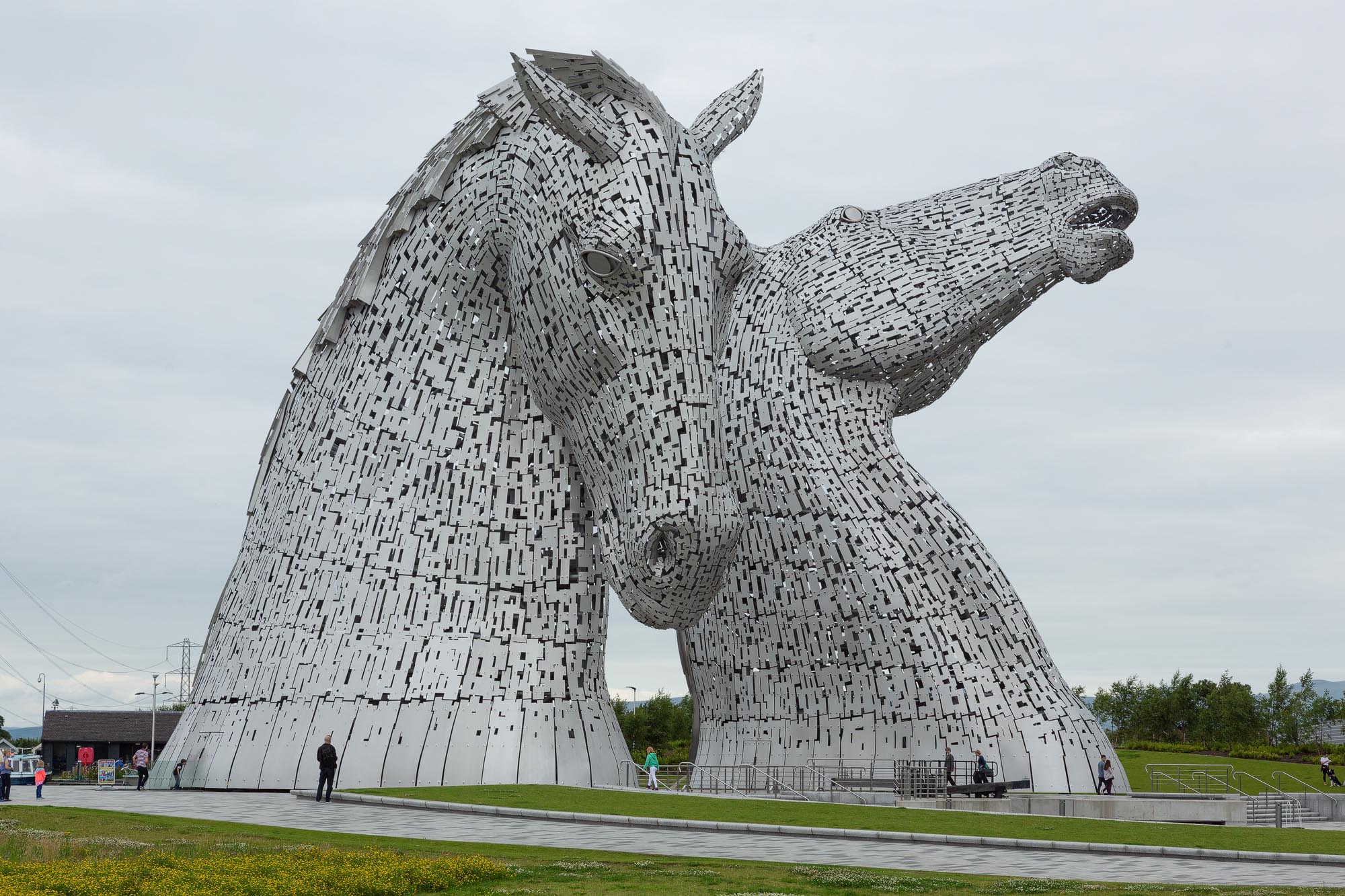
Rising 30 metres above the flat landscape between Falkirk and Grangemouth, The Kelpies are two monumental stainless steel horse head sculptures that have become one of Scotland’s most recognisable landmarks. Designed by Glasgow sculptor Andy Scott and completed in 2013, they are the largest equine sculptures in the world – a third taller than Antony Gormley’s Angel of the North – and have attracted millions of visitors since opening to the public in April 2014.
The sculptures stand as guardians at the eastern gateway of the Forth and Clyde Canal, within a vast parkland called The Helix. They are a tribute to the working horses that once powered Scotland’s canals and industry, and they take their name from the shape-shifting water spirits of Scottish folklore. Whether you visit in daylight to appreciate the intricate steel cladding up close, or after dark when they glow with colour reflected in the canal water, The Kelpies are genuinely breathtaking – and one of those rare attractions where the real thing is even more impressive than the photographs suggest.
The Legend of the Kelpie
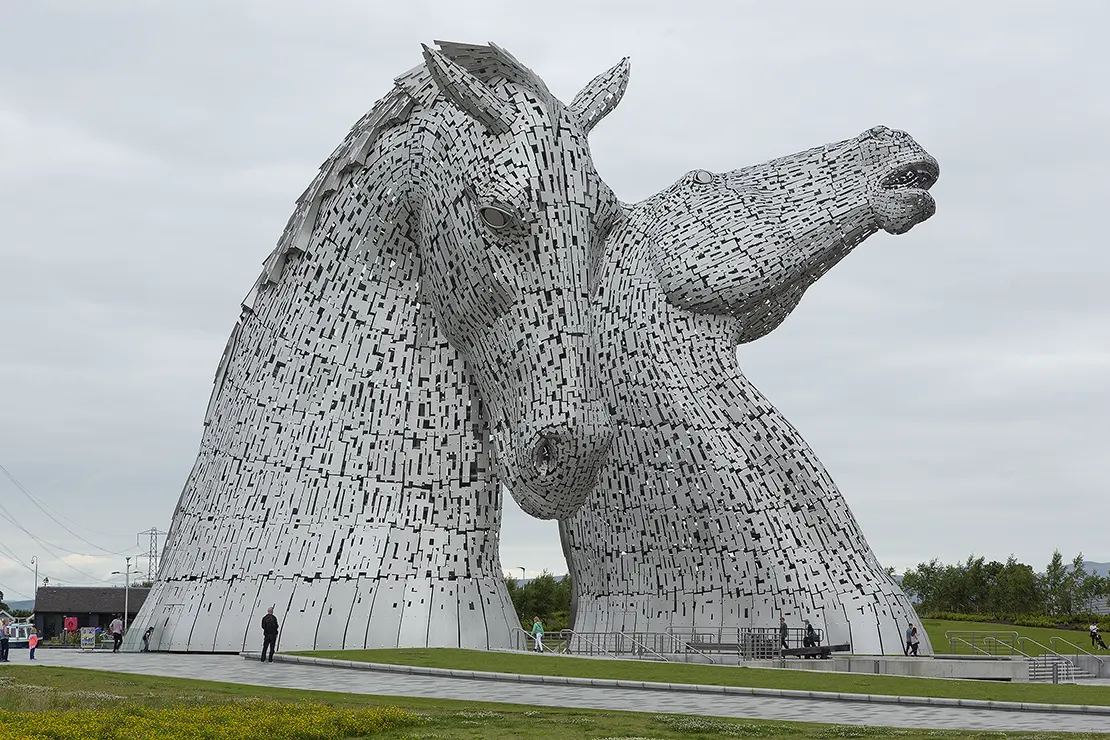
In Scottish folklore, a kelpie is a shape-shifting water spirit said to inhabit the lochs, rivers and streams of Scotland. Most often appearing in the form of a horse, kelpies were believed to lure unsuspecting travellers onto their backs before dragging them beneath the water to a watery grave. According to legend, a kelpie possessed the strength of ten horses and could sometimes be captured using a halter marked with a cross, after which it could be put to heavy labour.
The mythology varies across Scotland. Some traditions describe kelpies as taking human form – often appearing as a handsome young man or a beautiful woman – while others portray them purely as powerful, supernatural horses. The legendary Loch Ness Monster has sometimes been linked to kelpie folklore. The name was chosen for the sculptures by Scottish Canals to reflect these mythological beasts and their association with water, strength and endurance – qualities that also defined the real working horses of Scotland’s canals.
The Story Behind the Sculptures
Andy Scott and the Birth of an Idea
The sculptor behind The Kelpies is Andy Scott, a Glasgow-based artist already well known for large-scale public artworks, including the famous Heavy Horse sculpture on the M8 motorway. In 2005, Scottish Canals and Falkirk Council were developing plans for a major piece of public art as part of a regeneration project in the Falkirk area. They approached Scott in 2006, and he presented sketches of two enormous horse heads that would sit alongside the canal. The idea of horses came naturally – they had been central to canal life for generations, towing barges along Scotland’s inland waterways.
Scott’s first sketches were reportedly made on his girlfriend’s kitchen table, eight years before construction began. He later described his vision as shifting away from pure mythology toward something more grounded, creating a monument to the working horse and the lost industries of the Falkirk area. To bring the concept to life, he created two sets of 1:10 scale models, known as maquettes, in his Glasgow studio in 2007 and 2008. These miniature versions were laser-scanned to create precise digital models and toured internationally, appearing at Edinburgh Airport, the Field Museum in Chicago, Bryant Park in New York and various expos across Scotland.

Duke and Baron – The Real Horses
The two Kelpies were modelled on real horses. Duke and Baron were Clydesdale horses employed by Glasgow City Council to transport visitors and goods around Pollok Country Park. Duke became the model for the “head-down” Kelpie, while the slightly larger Baron modelled for the “head-up” Kelpie. Clydesdales were the breed traditionally used on Scotland’s canals, so it was fitting that two working Clydesdales formed the basis for sculptures celebrating that heritage. Both horses attended the opening ceremony in November 2013.
The Helix Project
The Kelpies are the centrepiece of The Helix, a £43 million land transformation project that converted over 350 hectares of what had been largely wasteland between Falkirk and Grangemouth into a vast community parkland. The project received £25 million from the Big Lottery Fund’s Living Landmarks programme and was designed to connect 16 communities in the Falkirk Council area. The Helix includes walking and cycling paths, a lagoon, adventure play areas, allotments and the canal basin where The Kelpies stand.
The wider context is the Millennium Link – a project costing over £80 million in total that restored central Scotland’s inland waterways to full use after more than half a century of abandonment. The most famous element of the Millennium Link is the Falkirk Wheel, the world’s only rotating boat lift, which opened in 2002 and is just a short drive from The Kelpies.
Construction and Engineering
Construction of The Kelpies began on site in June 2013, and remarkably, both sculptures were completed in just 90 days by October 2013. The fabrication was carried out by SH Structures of Yorkshire, who assembled large sub-sections at their facility before transporting them to Falkirk. Each sculpture is built around a tubular steel frame, with stainless steel panels cold-formed onto thousands of individual brackets to create the “skin” of the horses. In total, around 30,000 individual steel pieces were used across the two heads.
Each Kelpie stands 30 metres tall, weighs around 300 tonnes and is supported by 1,200 tonnes of steel-reinforced concrete foundations sunk into bedrock. The engineering required what the British Constructional Steelwork Association called “considerable engineering finesse” when awarding the project their Structural Steel Design Award in 2014. A topping-out ceremony was held on 27 November 2013, and the sculptures opened to the public in April 2014.

The Queen Elizabeth II Canal
The final piece of the Millennium Link puzzle came on 5 July 2017, when the late Queen formally opened the Queen Elizabeth II Canal – a new section of waterway that takes the eastern end of the Forth and Clyde Canal to its original starting and ending point in Grangemouth. The Kelpies stand as the gateway to this new canal, positioned either side of a specially constructed lock and basin. In the first year after opening, nearly one million people visited the site, and by the ten-year anniversary in 2024, over eight million people had visited in total. The sculptures are estimated to be spotted from the adjacent M9 motorway over 40 million times a year.
Our Visit
Getting There and Parking
On a recent trip to Falkirk, Janette and I had the Falkirk Wheel and The Kelpies both on our list. The Kelpies are located just off the M9 motorway – you can actually see them clearly as you drive past, which is quite a sight. There is no exit directly from the M9 to The Kelpies; you need to leave the motorway and follow the brown tourist signs for The Helix/Kelpies. If you are coming from Edinburgh, take the M9 towards Stirling and exit at Junction 5. From Glasgow, take the M80 towards Stirling, exit at Junction 8 for the M876, join the M9 and exit at Junction 6.
There are two car parks to be aware of. The Helix Car Park is the smaller one (78 spaces) near the park entrance – it is free for most of the year, though limited seasonal charges were introduced in 2025 (£3 per vehicle, 10am–2pm, July to September). The Kelpies Car Park is the larger one (175 spaces) closer to the sculptures and visitor centre, and this has seasonal charges that vary throughout the year. During the busiest summer months, it can cost up to £4 during the day. Free parking is also available at nearby Falkirk Stadium (home to Falkirk FC), which is about a 10-minute walk – though do check the football fixtures before relying on it! The stadium also has EV charging points.
First Impressions
Nothing quite prepares you for the scale of The Kelpies. We had seen them countless times in photographs and from the motorway, but walking toward them on foot is a completely different experience. They just keep getting bigger. By the time you are standing at their base and looking up, craning your neck, the sheer engineering achievement really sinks in. Each individual steel panel catches the light differently, and the way the sculptures seem to shift and shimmer as you move around them is mesmerising.

Exploring the Sculptures and Helix Park
We spent a good while walking around the sculptures, photographing them from every angle. From the front, you get the classic shot of both heads together. From the sides and rear, you can appreciate just how much steel has gone into the construction – and you can see the structural framework through the gaps in the cladding. There are nice touches around the site too, such as a poem by Jim Carruth engraved into the pathway near the car park.

Looking up from directly beneath the sculptures is a dizzying experience. You can see right into the interior framework through the gaps in the steel cladding – it looks like a roller coaster inside. The “head-up” Kelpie (Baron) has a wonderful sense of movement and power, while the “head-down” one (Duke) feels calmer and more contemplative. Together they create a real sense of drama, especially with the canal basin and lock between them.


The Visitor Centre
The Kelpies Visitor Centre is a short walk from the sculptures and serves as the hub for the site. Inside you will find a café serving hot drinks, snacks and artisan ice cream, a gift shop with Kelpie-themed souvenirs, and a small exhibition space. The kids loved the Lego Kelpies in the exhibition area. Toilet facilities are available here. The Plaza Café, which overlooks the Helix Lagoon, is also worth a stop and is open seasonally from April to October.
This is also where you book the guided tours. For £8.50 per adult (£7.50 concession, two children free per paying adult), you get a 25-minute tour that takes you inside one of the sculptures. It is the only way to see the interior engineering up close, and by all accounts it is well worth doing. Tours depart from the visitor centre at timed slots throughout the day. The visitor centre is open 9am to 5pm, seven days a week.
The Kelpies After Dark
The Kelpies are fantastic in daylight, but they come into their own after sunset. Internal lighting illuminates the sculptures from within, and the colours change regularly – cycling through blues, greens, purples, reds and golds. The effect reflected in the canal water is spectacular, especially on a still evening. On special occasions, The Kelpies may be lit in a specific colour to mark the event – you can even request a particular colour through Scottish Canals’ “Light Up our Landmarks” scheme.

The lighting comes on at dusk and stays on until dawn, so in winter you can see them illuminated as early as 4pm. The site is accessible 24 hours a day, though the visitor centre and café close at 5pm. If you can time your visit for dusk, you get the best of both worlds – daylight views followed by the illuminated spectacle. We found a late afternoon visit worked perfectly.
Things to Do at The Helix Park
The Kelpies are the headline act, but there is plenty more to see and do in The Helix Park. The Adventure Zone is a brilliant playground with a large assault course, climbing structures and slides – our kids loved it. The Splash Play area nearby has jets of water that shoot up from the ground with coloured lights, ideal for younger children on a warm day. The adventure area also has an excellent accessibility section for wheelchair users, including an adapted see-saw and roundabout.
The Helix has over 26 kilometres of interconnected walking and cycling paths, and it sits on two National Cycle Routes (754 and 76) as well as the John Muir Way. The HArTT route (Helix Around Town Trail) is a 25-kilometre circular cycle that takes in The Kelpies, Callendar Park and the Falkirk Wheel. The lagoon is a peaceful spot for wildlife watching, and the Forth and Clyde Canal towpath offers flat, easy walking in both directions. For those exploring Scotland by itinerary, The Kelpies make an ideal stop between Edinburgh and the Highlands.
Frequently Asked Questions
Do you have to pay to see The Kelpies?
No. Visiting The Kelpies and walking around the sculptures is completely free, 24 hours a day, 365 days a year. The only cost is for parking (the Helix Car Park is free most of the year, while the Kelpies Car Park has seasonal charges) and for the optional guided tour inside the sculptures.
Can I go inside The Kelpies?
Yes, but only on a guided tour booked through the visitor centre. Tours cost £8.50 per adult, £7.50 for concessions, and two children go free with each paying adult. The tour lasts around 25 minutes and gives you a fascinating look at the internal engineering. Book in advance during peak season as tours can sell out.
What time do The Kelpies light up at night?
The lighting comes on at dusk and stays on until dawn. In winter this can be as early as 4pm; in summer it may not be until 10pm or later. The colours change regularly, and on special occasions The Kelpies are lit in a specific colour. The site is open 24 hours, so you can visit at any time to see the illuminations.
How long does a visit to The Kelpies take?
A quick stop to see the sculptures and take photographs takes around 30 to 45 minutes. If you want to explore the wider Helix Park, visit the café, take the guided tour, and let the kids loose in the Adventure Zone, you could easily spend two to three hours here.
Are dogs allowed at The Kelpies?
Dogs are welcome in The Helix Park and around the sculptures, but only assistance dogs are permitted on the guided tour inside The Kelpies.
Is The Helix Park accessible for wheelchair users?
Yes. The paths throughout the park are wide and flat, and there is disabled parking available directly outside the visitor centre entrance. The Helix also has three wheelchairs available to loan free of charge, which can be reserved in advance by telephone or email. The Adventure Zone includes accessible play equipment.
Can I park a motorhome or campervan at The Kelpies?
Yes. Campervans and motorhomes can park overnight in The Helix Car Park for a small charge. Be aware that it is a car park rather than a campsite, so there are no camping facilities provided. Vehicles over 8 metres in length cannot be accommodated for overnight parking.
What is the best time to visit The Kelpies?
Spring through early autumn (April to October) offers the best weather and the longest opening hours for the visitor centre, café and seasonal attractions like the Splash Play. However, visiting around dusk at any time of year is rewarding, as you can see the sculptures in daylight and then watch them light up. Summer weekends and school holidays are the busiest times for parking.
Key Information
- Location: The Helix, Falkirk/Grangemouth, FK2 7ZT
- OS Grid Reference: NS 92138 82154
- Managed by: Scottish Canals / Falkirk Community Trust
- Entry: Free (guided tours £8.50/adult)
- Parking: Two car parks – Helix Car Park (free most of the year) and Kelpies Car Park (seasonal charges). Free parking at Falkirk Stadium nearby.
- Facilities: Visitor centre, café, gift shop, toilets, adventure playground, splash play (seasonal)
- Accessibility: Flat, wide paths throughout. Disabled parking at visitor centre. Free wheelchair loan available.
- Dogs: Welcome in the park. Assistance dogs only on guided tours.
- Opening: The sculptures are accessible 24/7. Visitor centre open 9am–5pm daily.
What Else is Nearby?
The Falkirk Wheel is the obvious companion visit – the world’s only rotating boat lift is about a 15-minute drive (or a pleasant canal-side walk of around 4 miles) from The Kelpies. Boat trips on the wheel are available, and there is a visitor centre with a gift shop and café. You could comfortably fit both The Kelpies and the Falkirk Wheel into one day.
Callendar Park in Falkirk town centre is about a 12-minute drive from The Helix and makes another great stop, particularly for families. The park has a large play area, woodland walks, and the historic Callendar House with its visitor centre and tearoom. Part of the Antonine Wall – the Roman frontier that once stretched across Scotland – runs through the park grounds.
To the north, Stirling is around 25 minutes away by car and offers Stirling Castle, the Wallace Monument and the historic Old Town. If you are heading to or from Edinburgh, The Kelpies make an ideal stopping point – the city is only about 45 minutes away on the M9, and there are plenty of free things to do in Edinburgh once you arrive.
Conclusion
We had a fantastic visit to The Kelpies, and I would recommend them to anyone visiting Scotland. They are one of those rare attractions that genuinely exceeds expectations – photographs simply cannot convey the scale and detail of these sculptures. The surrounding Helix Park is excellent too, with plenty for families, and combining a visit with the nearby Falkirk Wheel makes for a brilliant day out in central Scotland. If you are planning a week-long trip around Scotland, do not drive past on the M9 without stopping – you will not regret it.



Leave a comment below